BACKGROUND
I joined the business unit where I now work in March of 2022. Although the business unit has 3,800 people total, prior to me joining there was no industrial engineering team and the continuous improvement team that existed had 3 people who were more focused on deploying tools than on driving bottom-line business results. I was hired as the industrial engineering manager, and my charter was to build a department that could build and deploy industrial engineering and lean principles across the organization to enable profitable growth.
Two years later our industrial engineering team consists of 10 team members located across 3 campuses in northern Utah. We are a small department, but I am proud of the team and the demonstrable impact we have had in 24 months. Our team members have various backgrounds, tenures, and life experiences, but I am confident to say we are all mission-focused and understand our purpose within the company. As change agents and engineers that bridge the technical and financial aspects of the business, it is important that we recognize that providing a technical solution is only about half of the battle – the other half is selling the vision or reason for the change and then sustaining the implementation. Soft skills play a large factor in our team’s success.
While I am confident that any member of the IE team would be able to define what we do, I will admit that we might have struggled to define who we are and how the collective “we” approach our work. I am not concerned with our team’s technical capability, but rather our identity, the reputation that we are working to build and how we interact with the broader organization.
PROJECT
My leadership style has been greatly influenced by my time in the Organizational Leadership program. More specifically, my concentration in servant-leadership has made me a more well-rounded person who leads intentionally and thoughtfully. For my project, I wanted to showcase these leadership skills that I have developed as well as positively impact the IE department I lead.
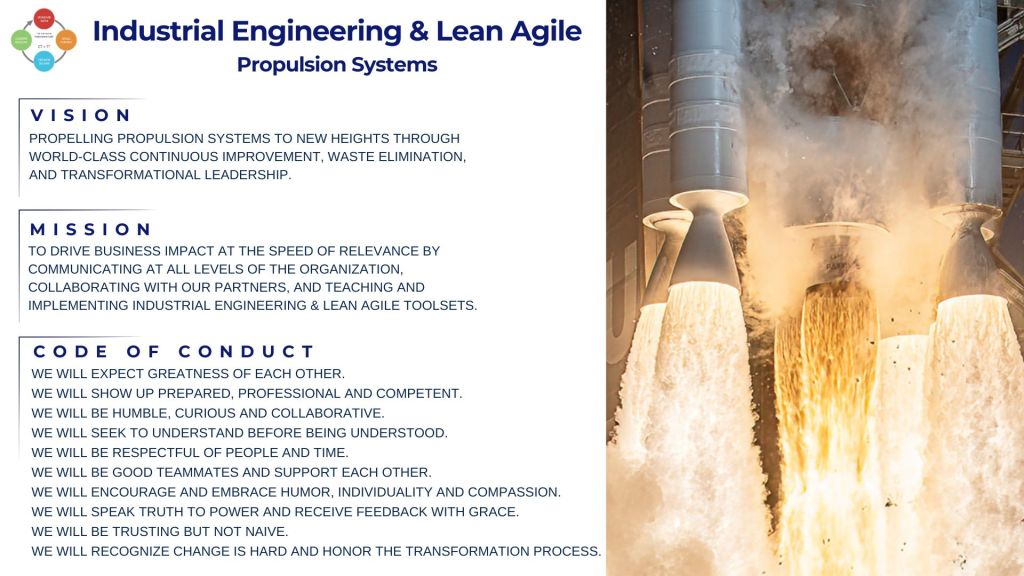
I facilitated the defining of our department’s Vision, Mission and Code of Conduct amongst our department team members. The document is meant to be professionally printed and distributed to team members.
The benefit of defining our Vision, Mission and Code of Conduct came from the process of developing these things together as a team through a series of reflective and introspective sessions I facilitated. Through this activity, I had the opportunity to employ all 10 characteristics of Servant Leadership identified by Larry Spears in the introduction to Servant Leadership (Greenleaf, 1977).
10 Characteristics of Servant Leadership
- Listening
- Empathy
- Healing
- Awareness
- Persuasion
- Conceptualization
- Foresight
- Stewardship
- Commitment to the growth of people
- Community building
In defining our collective vision, I asked the team to dream great dreams and think well beyond our current situation and capabilities. I encouraged us to collectively define a vision of being wildly successful – whatever form that takes.
Our mission statement answers how we intend to fulfill our vision. Our team has people with varying levels of capabilities, tools and experience, yet we want to be united in our approach. How we work matters, and I wanted our team members to be thoughtful in the development of how we advance toward our vision.
Finally, our code of conduct is a series of statements that answer how we expect one another to show up and interact every day. Proverbs 27:17 states, “as iron sharpens iron, so one man sharpens another”. Our code of conduct seeks to answer how we are making ourselves, each other and our organization better through our day-to-day interactions.
PROJECT ASSEMBLY
Across six one-hour sessions, my team and I shared, brainstormed, edited and finalized our Vision, Mission and Code of Conduct. Throughout these working sessions, I took a primus inter pares approach to facilitate and guide the conversation. I was careful to listen first, to welcome debate, and to give everyone the opportunity to help craft who we are, where we are going and how we will conduct ourselves.
To help encourage people to speak and to give people the time to develop their thoughts, the first four sessions were breakout sessions with only one half of the team present.
For session one and session two, I separated the team in half and I captured our groups’ thoughts separately. I intentionally did not want one group to build on the ideas of the other at this point. For these sessions, we focused primarily on the Vision, some on the Mission, and very little on the Code of Conduct.
Next, for session three and session four, I divided the team in half again, but intentionally comprised the teams of different members. I merged the content from session one and session two, and let people build off of all the ideas that were presented in the first two sessions. For session three and session four, we refined the Vision, developed the Mission and again just captured broad thoughts for the Code of Conduct.
Session five was the first session with the entire team present. By this point, I sensed that people had developed an understanding of the process and what we were trying to do, a sense of ownership, and a level of comfort that enabled them to share their viewpoints. We finalized the Vision and Mission.
In advance of session six, I had the team members send me their thoughts for what we would look for in future team members, how we as team members should treat one another, and what we expect of one another. I grouped the teams points by themes, and presented the team with a list of 22 statements. During session six, we added, revised and ultimately pared the list down to 10 statements. Lastly, we prioritized the order that we would present the list.
MANIFESTED COMPETENCIES
In my project where we have been crafting my department’s Vision, Mission and Code of Conduct, I have had the opportunity to display the following manifested competencies:
Community Building: The notion of creating community is a competency that I have greatly developed during my time in the Organizational Leadership program. When I first read Larry Spears describe Community Building as a trait of servant-leaders, I ended up not giving it much thought because it sounded so foreign to me. However, I have come to greatly appreciate this aspect of servant-leadership and have made it a point to be more proactive in making people feel welcome and have a sense of belonging on my team. By crafting the Vision, Mission and Code of Conduct together, I have helped the team create an artifact that is not mine, not theirs, but ours. We’ve even discussed how we will handle editions to the artifact when new members join the team. Chittister (2004) states, “The Rule of Benedict says that if you want to be holy, stay where you are in the human community and learn from it. Learn patience. Learn wisdom. Learn unselfishness. Learn love” (p. 33).
Creating Psychological Safety: I was intentional to create a space where people felt safe to share, to debate me and others and to provide their input. It was interesting watching my team members’ involvement increase over the course of the development of the Vision and Mission for our department. What may have started for some as a superficial exercise grew into something that we created, and therefore each and every one of us cared deeply about. People presented their ideas and opinions, and at times defended them, but always with respect for their peers and respect for the process. Palmer (1993) says, “too many of us subscribe to a weak doctrine of pluralism, to the simple notion that truth looks different when viewed from different angles. Because this notion concedes diversity without calling us into dialogue, it leaves us in isolation and destroys community as effectively as the objectivism it seeks to resist” (p. 66).
Generative Listening: By listening first, I have yielded my positional power in the department and allowed my team members to share their thoughts, their perspectives and their logic. This has allowed us to create a foundation based on shared understanding by which we have been able to develop and evolve what we want our department to be. “The most critical difference between successful and unsuccessful organization leaders is in their ability to listen to, hear, and genuinely understand the perspective of others.” (Thompson, 2000, p. 180)
Vision Setting: As obvious as it may seem, crafting the Vision, Mission and Code of Conduct with the team has been an exercise in Vision Setting. Aside from the words that we are putting on paper to represent our Vision, my actions as a leader have also communicated to my team where I expect we are going as a team. We have completed five sessions dedicated to crafting this team artifact, and I am extremely pleased with everyone’s participation. My actions and willingness to invest time in this have shown the team that this is important, and that us acting as one unit is also important. “By clearly stating and restating the goal the leader gives certainty to others who may have difficulty in achieving it for themselves. (Greenleaf, 2002, p. 29)
Silence: Allowing silence to fall on the room during the creation process has visibly made people uncomfortable at times, but it has also brought forth ideas and comments that I am confident would not have seen the light of day without the silence allowing people to be more thoughtful than they might have otherwise been if they were simply waiting their turn to speak. I have learned in the Organizational Leadership program that silence is not the absence of sound, but rather its own entity that can be called upon as a leader and that can yield tremendous insights, calmness, clarity, and awareness. “We now have to learn to invite the Silence, and having invited it, we now have to learn to enter it” (Sardello, 2008, p. 12).
Empathy: I am rather in tune to my own aspirations and shortcomings, but by creating the space for people to help craft where we want to go as a department, I have also created a space where I can better understand my team members and who they want to become. According to Greenleaf (2002), “there is something subtle communicated to one who is being served and led if, implicit in the compact between servant-leader and led, is the understanding that the search for wholeness is something they share” (p. 50)
REFERENCES:
Chittister, J. (2004). The rule of Benedict : insights for the ages. Crossroad.
Greenleaf, R. K. (2002). Servant leadership: A journey into the nature of legitimate power and
greatness. New York, NY: Paulist Press.
Palmer, P. J. (1993). To Know As We Are Known : Education as a Spiritual Journey. HarperOne.
Sardello, R. (2008). Silence: The Mystery of Wholeness. North Atlantic Books.
Thompson, C. M. (2000). The congruent life : following the inward path to fulfilling work and inspired leadership. Jossey-Bass.
 wadewestwood.com